November 2026 Mortgage Rate Forecast: What It Means for Your Home Equity
Mortgage rates head toward November above 7%, leaving homeowners with an important decision: whether accessing cash is worth replacing an existing low-rate mortgage.
Freddie Mac’s latest available survey puts the average 30-year fixed mortgage rate at 7.18%, down from 7.24% the previous week but above 6.22% a year earlier. Meanwhile, Fannie Mae’s October forecast projects a 7.4% average for the fourth quarter, not a return to substantially lower borrowing costs before year-end.
For homeowners with a 3% or 4% mortgage, the most useful question may not be, “When will rates fall?” It may be, “How can I compare equity-access options without unnecessarily increasing the cost of my existing mortgage?”
Here’s the November outlook, what it means for your equity, and how to compare borrowing structures before choosing one. If you are deciding whether to borrow now, see whether to tap your equity now or wait.
Mortgage Rates Heading Into November 2026
Rates have now fallen for three straight weeks, which offers some relief, but they remain higher than they were a year ago.
| Mortgage benchmark | November 5, 2026 | Previous week | One year earlier |
|---|---|---|---|
| 30-year fixed | 7.18% | 7.24% | 6.22% |
| 15-year fixed | 6.57% | 6.60% | 5.50% |
Source: Freddie Mac Primary Mortgage Market Survey, released November 5, 2026.
These figures are benchmarks, not personalized offers. Freddie Mac’s survey reflects conventional, conforming home-purchase mortgage applications. It does not establish the rate you will receive on a cash-out refinance, HELOC, or home equity loan.
Use the survey to understand the market’s direction, then compare actual quotes for the financing you need.
November Mortgage Rate Forecast: Don’t Build Your Plans Around a Big Drop
Fannie Mae’s October outlook projects average 30-year mortgage rates of 7.4% in the fourth quarter of 2026 and 7.5% throughout 2027. That is a substantial upward revision from its September expectations of 6.8% for the fourth quarter and 6.7% for 2027.
| Forecast period | Fannie Mae’s October projection |
|---|---|
| Fourth quarter of 2026 | 7.4% |
| Full year 2027 | 7.5% |
These are period averages, not November-specific predictions, daily rate targets, or guarantees. Source: Fannie Mae Housing Forecast, October 2026.
The revision itself is a reminder that forecasts can change. A forecast published only a month earlier painted a meaningfully different picture.
For November planning, consider three possibilities:
- Rates decline: Request updated quotes and check whether the improvement materially changes your payment or costs.
- Rates remain near current levels: Compare the available options rather than assuming waiting will solve an affordability problem.
- Rates rise: Reassess the amount you need, your repayment timeline, and whether the expense can be reduced or delayed.
The practical approach is to make a decision that works under today’s quoted terms, rather than one that depends on a future refinance or an anticipated rate decline.
What Higher Mortgage Rates Mean for Your Home Equity
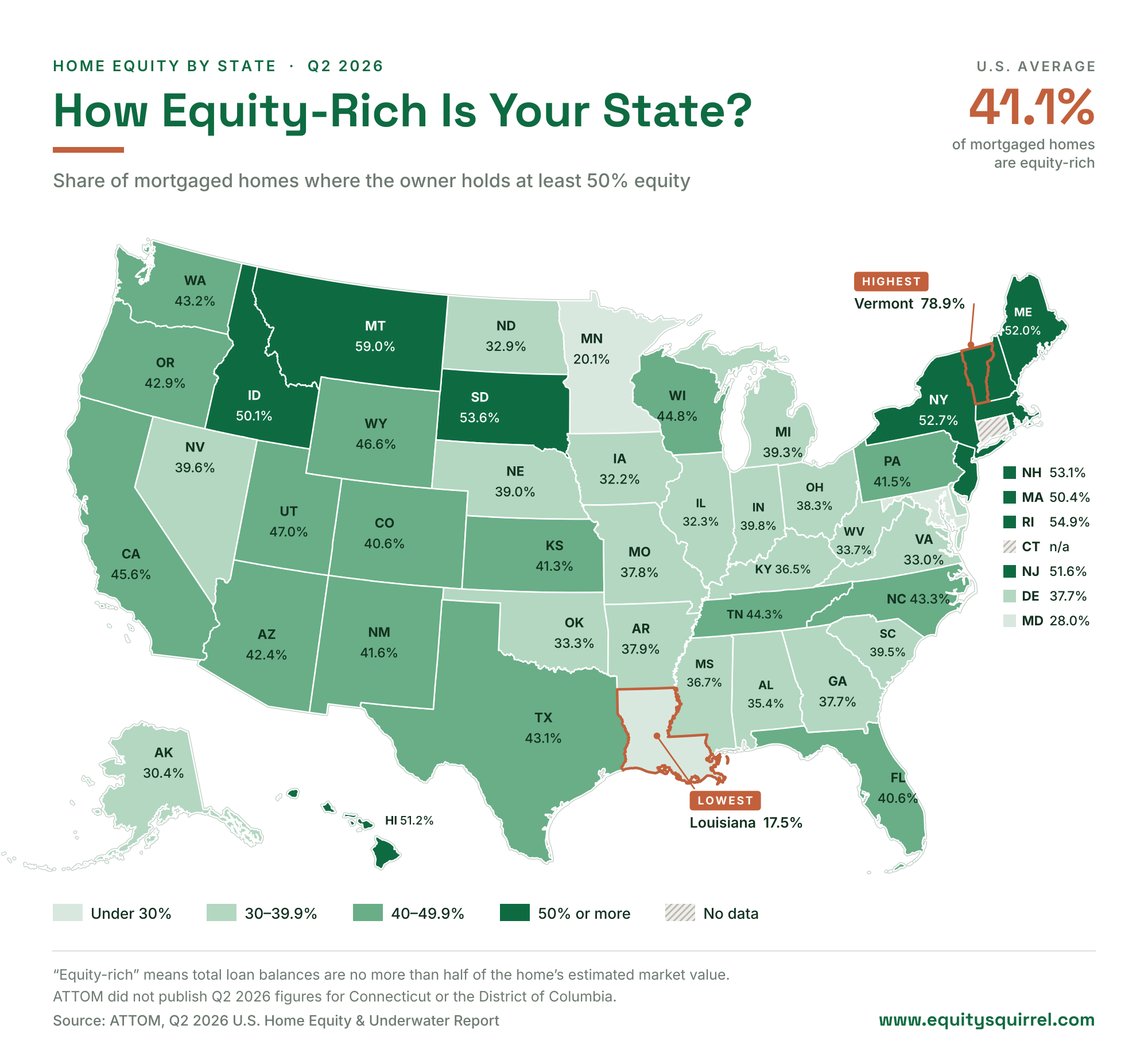
Many homeowners weighing this choice have plenty of equity to work with. In Q2 2026, 41.1% of mortgaged U.S. homes were equity-rich, meaning the loan balance was no more than half the home’s estimated value, according to ATTOM. The share ranged from 17.5% in Louisiana to 78.9% in Vermont.
For a homeowner considering a cash-out refinance, the key distinction is between borrowing additional money and repricing money already borrowed.
A cash-out refinance replaces the existing mortgage with a larger new mortgage. By contrast, a standalone home equity loan or HELOC can provide additional financing while leaving the existing first mortgage in place. The CFPB identifies both as common ways homeowners access equity.
That creates a comparison that advertised interest rates alone cannot resolve.
A second loan may carry a higher rate than a new first mortgage, but it applies that rate to a smaller balance. A cash-out refinance may offer a lower rate on the additional borrowing while also changing the rate and repayment schedule on the existing mortgage.
The following example shows why the full structure matters.
Example: Accessing $50,000 Without Replacing a Low-Rate Mortgage
Suppose a homeowner has:
- A $300,000 mortgage balance.
- A fixed rate of 3.50%.
- Exactly 30 years remaining.
- A need for $50,000 in additional cash.
Compare two hypothetical options:
- Keep the mortgage and add a $50,000 fixed-rate home equity loan at 9.00% over 15 years.
- Replace the mortgage with a $350,000 cash-out refinance at 7.32% over 30 years.
The rates are illustrative assumptions, not lender offers. The refinance rate uses the purchase-market benchmark solely to demonstrate the calculation; actual cash-out pricing may differ.
| Payment comparison | Keep mortgage + home equity loan | Cash-out refinance |
|---|---|---|
| Existing mortgage payment | $1,347 | Replaced |
| Home equity loan payment | $507 | Not applicable |
| New refinance payment | Not applicable | $2,404 |
| Combined monthly principal and interest | $1,854 | $2,404 |
Hypothetical example. Calculations assume monthly amortization and exclude closing costs, taxes, insurance, and other charges. Figures are rounded.
Under these assumptions, keeping the existing mortgage and adding the home equity loan produces a combined payment about $550 lower per month.
The reason is straightforward: the homeowner preserves 3.50% financing on $300,000 and pays the higher rate only on the additional $50,000.
Ways to Access Equity While Keeping Your First Mortgage
HELOC: Compare Flexibility With Payment Uncertainty
A home equity line of credit provides revolving access to funds during a draw period. You generally pay interest on the amount borrowed rather than the full available credit line. HELOCs typically have variable rates, and some allow interest-only payments during the draw period.
That structure can help when expenses occur over time, but the initial payment should not be the only number you evaluate.
Before choosing a HELOC, ask:
- Is the quoted rate introductory?
- How are the index and lender margin calculated?
- What payment is required during the draw period?
- What happens when repayment begins?
- Can any balance be converted to a fixed rate?
A variable-rate HELOC’s payment can change even without additional borrowing, so evaluate a higher-payment scenario as well as the initial quote.
Home Equity Loan: Compare Fixed Payments and Total Costs
A fixed-rate home equity loan provides a lump sum with a scheduled repayment period. Unlike a typical variable-rate HELOC, its fixed rate provides a more predictable principal-and-interest payment.
For a defined expense, that can make the comparison easier: you know how much you are borrowing and the scheduled payment.
Still, compare the interest rate, fees, term, and total repayment, not just whether the monthly payment fits your budget. In the example above, the home equity loan works favorably because of the relationship between the existing mortgage, the new borrowing amount, and both repayment schedules.
Home Equity Agreement: No Monthly Payment Does Not Mean No Cost
Home equity agreements (also called home equity investments or shared equity agreements) provide upfront cash in exchange for a future settlement tied partly to the home’s value. They typically do not require scheduled monthly payments, but they do require repayment under the contract’s terms.
The settlement is not always a simple percentage of future appreciation. Providers may use different formulas, valuation adjustments, multipliers, and caps. Those differences can materially affect the amount owed.
Before signing, request settlement illustrations for several time horizons and home-value scenarios. Review:
- Upfront fees and net proceeds.
- The starting valuation and any adjustments.
- The settlement formula and applicable caps.
- Treatment of renovations.
- Events that trigger repayment.
- Your ability to refinance or sell.
The CFPB warns that homeowners who cannot fund the eventual lump-sum settlement may have to sell their home or face foreclosure. An agreement should therefore include a realistic repayment plan, not just a plan for using the upfront cash.
Read nextHow HEI Safety Caps Limit What You OweWhen Should You Still Consider a Cash-Out Refinance?
Keeping an existing mortgage should be a comparison point, not an automatic conclusion.
The example above depends on a relatively large existing balance at a low rate. Change those assumptions, and the outcome can change.
Run a fresh comparison when:
- Your existing mortgage rate is closer to, or above, the refinance quote.
- Your remaining mortgage balance is small relative to the cash needed.
- The available second-loan quotes are expensive.
- You want a different repayment schedule.
- Closing costs materially differ between options.
Request side-by-side calculations using the same cash requirement and a consistent comparison period. A lower monthly payment deserves particular scrutiny when it comes from extending repayment.
Your November Home Equity Checklist
Before choosing an option, gather the information needed for an apples-to-apples comparison.
- Review your existing mortgage. Record the balance, rate, payment, and remaining term.
- Define the cash requirement. Separate the amount you need from the maximum amount you might qualify to access.
- Request written terms. Compare rates, fees, repayment schedules, and net proceeds.
- Test the future obligation. Evaluate higher HELOC payments or different home equity agreement settlement amounts where relevant.
- Compare a consistent time horizon. Include payments, fees, and the balance or settlement obligation remaining when you expect to sell or repay.
The central principle is comparison: evaluate the cost of accessing new cash alongside the consequences for your existing mortgage.
Frequently Asked Questions
Will Mortgage Rates Fall in November 2026?
A decline is possible, but the available forecast does not support counting on a major drop. Fannie Mae’s October outlook projects a 7.4% average 30-year mortgage rate for the fourth quarter. That is a quarterly average, not a precise prediction for November.
Can I Access Equity Without Changing My Existing Mortgage?
Yes. A standalone HELOC or home equity loan can provide additional financing while leaving the first mortgage in place. Home equity agreements are another option, but they have different cost and settlement structures that require careful review.
Is a HELOC Cheaper Than a Cash-Out Refinance?
Not automatically. Compare the combined cost of keeping your mortgage and adding a HELOC with the cost of replacing the mortgage. Include fees, repayment terms, variable-rate exposure, and remaining balances, not just the advertised rates.
Does a Home Equity Agreement Eliminate Repayment?
No. The absence of scheduled monthly payments does not eliminate the obligation. Homeowners generally owe a lump-sum settlement by the contract’s deadline or after a triggering event, such as selling the home.
Find the Right Way to Access Your Home Equity
Before replacing your mortgage, compare what it would cost to keep it. Your existing rate, the amount of cash you need, and your repayment timeline should guide the decision, not just an advertised rate or a prediction about where rates are headed.
Explore EquitySquirrel’s HELOC, home equity loan, and home equity agreement guides to compare costs, understand the trade-offs, and choose your next step with confidence.
This article provides educational information, not personalized financial, legal, or tax advice. Loan examples are hypothetical and exclude costs unless stated otherwise.
EquitySquirrel is an educational resource operated by Scout Media LLC, not a lender or HEI provider. This content does not constitute financial, legal, or investment advice. HEI terms vary by provider and are subject to change; confirm current terms directly. Consult a licensed financial professional before making decisions about your home equity. Aleksandra Kadzielawski, Lic #SA694336000.