Kitchen Remodel Cost in Phoenix: 2026 HELOC Guide
The Scout Executive Summary
- A Phoenix mid-range kitchen prices near $33,000 in cost models and $40,000 to $75,000 in contractor quotes. That gap is not an error, and understanding what sits inside it is the difference between a budget that holds and one that does not.
- A HELOC fits a remodel better than most financing because you draw in stages. You pay interest only on what you have actually taken out, which matches how contractors bill.
- Most Phoenix homeowners have far more room than the project needs. Valley lenders commonly allow 80% to 85% combined loan-to-value, and a few local credit unions go higher for improvement projects specifically.
In this Article
- How Much Does a Kitchen Remodel Cost in Phoenix in 2026?
- Can You Use a HELOC to Pay for a Kitchen Remodel?
- How Much HELOC Can You Get for a Phoenix Kitchen Remodel?
- What Is the Monthly Payment on a HELOC for a Kitchen Remodel?
- Is a HELOC or a Home Equity Loan Better for a Remodel?
- Does a Kitchen Remodel Increase Home Value in Phoenix?
- Is HELOC Interest Tax Deductible for a Kitchen Remodel?
- What If You Cannot Qualify for a HELOC?
- Frequently Asked Questions
How Much Does a Kitchen Remodel Cost in Phoenix in 2026?
Cost models put a typical Phoenix mid-range kitchen near $33,000, while Valley remodeling firms quote the same scope at $40,000 to $75,000. That gap is the most useful thing to know before you budget. Cost models price materials and labor. Contractor quotes price permits, design fees, demolition surprises, and margin. Neither is wrong, and the difference between them is roughly what you should expect to spend beyond the raw cost of the work.
Curious if a HELOC fits your budget? Estimate your rate today.
Mid-range remodel, Phoenix metro, 2026
The space between the two bars is the gap: permits, design fees, demolition surprises and margin. Budget for it rather than assuming the model number.
Treat published metro averages carefully for the same reason. Estimators covering Phoenix currently report typical figures from about $18,000 to over $40,000, and they do not even agree on direction: one puts Valley labor 3% below the national average, another puts it 5% above. They are pricing different scopes and calling them the same thing.
The tier you pick is the number that matters:
- Cosmetic refresh, roughly $15,000 to $30,000. Cabinet boxes stay. You replace door fronts and hardware, add new counters, a sink and faucet, one or two appliances, and paint. No layout changes.
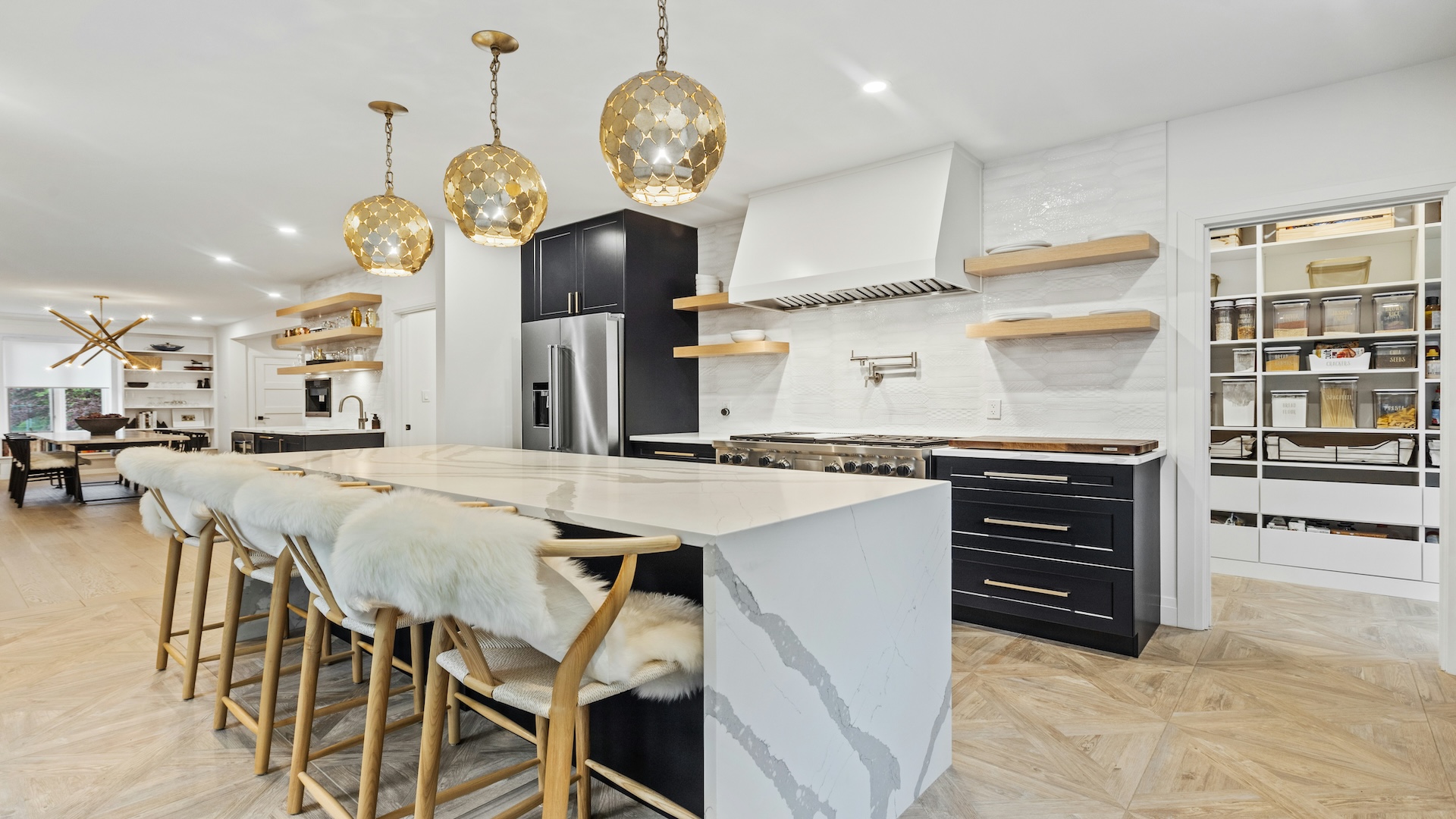
- Mid-range remodel, roughly $35,000 to $75,000. New semi-custom cabinets, stone counters, all new appliances, new flooring and lighting. Layout stays the same.
- Major or custom remodel, $75,000 to $150,000 and up. Walls move, plumbing relocates, cabinetry is custom.
Two Phoenix-specific factors are worth building into your budget. Local labor rates track close to the national average, so the Valley is not a cheap market or an expensive one, and your contractor selection drives more of the price than your ZIP code does. Second, quotes for identical scope routinely vary 20% to 40% between Arizona contractors, so three bids is a floor, not a nicety. Verify Arizona ROC licensing on every bid.
Can You Use a HELOC to Pay for a Kitchen Remodel?
Yes, and the structure of a HELOC lines up with how a remodel actually gets paid better than almost any other option. A HELOC is a revolving line of credit secured by your home. You are approved for a total limit, then draw against it as you need the money, and you pay interest only on the amount you have drawn.
Planning for a major expense? Check your HELOC eligibility online.
That matters because contractors do not ask for the full amount on day one. A typical Phoenix remodel runs on a deposit followed by milestone payments as work completes. With a lump-sum loan, you would take the entire amount at closing and start paying interest on all of it while it sits in your checking account. With a HELOC, a $50,000 project that draws $10,000 in month one costs you interest on $10,000, not $50,000.
The other practical advantage is scope creep, which is close to universal on kitchen jobs. When demolition uncovers a plumbing problem or you decide mid-project to redo the lighting, an open line absorbs the overage without a second loan application.
The tradeoffs are real. HELOC rates are variable and move with the prime rate, so your payment is not fixed. Your home secures the line, which means missed payments put the house at risk. Arizona is a deed-of-trust state with non-judicial foreclosure, meaning a lender can foreclose without going to court, so payment discipline matters more here than in judicial-foreclosure states.
How Much HELOC Can You Get for a Phoenix Kitchen Remodel?
Most Arizona lenders cap your combined loan-to-value at 80% to 85%, which for a typical Valley homeowner leaves far more room than a kitchen needs. Combined loan-to-value, or CLTV, is every loan against your home added together and divided by the home’s value.
Don’t want to wait weeks for bank approval? Check your online rate instantly.
Here is the math on a Phoenix-area home:
- Home value: $520,000
- First mortgage balance: $310,000
- At an 80% cap: $416,000 total allowed, minus $310,000, leaves $106,000
- At an 85% cap: $442,000 total allowed, minus $310,000, leaves $132,000
Either figure covers a mid-range remodel with room to spare. This is the position most Valley homeowners who bought before 2022 are in, and it is why so many Phoenix kitchens get financed this way rather than through a cash-out refinance that would surrender a low first-mortgage rate.
One Arizona detail worth knowing: a few local credit unions allow higher loan-to-value specifically for home improvement projects, well above the standard 85% cap. These programs are narrow and the terms change, so confirm current limits directly with the lender before you plan around them.
🐿️ Scout’s Tip: Rate shop before you scope the project, not after. The gap between the best and worst HELOC pricing in the Valley is wide enough to change what you can afford to build. Our Arizona home equity rates page tracks current HELOC and home equity loan pricing for local homeowners so you can walk into contractor bids knowing your real cost of money.
What Is the Monthly Payment on a HELOC for a Kitchen Remodel?
A $40,000 draw at 7.25% costs about $242 a month during the draw period and about $365 a month once repayment begins, a jump of roughly 51%. You pay interest only on what you have actually drawn while the line is open, and then the payment resets to include principal.
Curious how much equity you can unlock? Check your rate in minutes.
- Draw period, interest only: about $242 per month
- Repayment period, 15-year amortization: about $365 per month
$40,000 drawn at 7.25%
The payment rises 51% when the draw period ends, on a schedule set years in advance. Rates are variable, so both figures move with prime.
That increase arrives on a schedule set years in advance. Many Valley HELOCs run a 10-year draw followed by a 15 or 20-year repayment period, so you get a decade of the low payment and then the real one. Rates are variable, so if prime moves, both numbers move with it.
Two things to confirm with any lender before you sign:
- When does the draw period end, and what is the repayment term? A shorter repayment term means a bigger jump.
- Is there a fixed-rate conversion option? Some Arizona lenders let you lock a portion of your drawn balance at a fixed rate, which caps your exposure on the part of the remodel you already spent.
Looking for a no monthly payment option? A Home Equity Investment skips the monthly payment and the income check, but takes four to six weeks and costs more in a rising market. Compare Arizona HEI providers.
🐿️ Scout’s Tip: If the monthly payment is what is stopping you rather than the equity, look at a Home Equity Investment before you shrink the project. An HEI trades a share of your home’s future value for cash today with no monthly payment at all, and Splitero specifically excludes the value your renovation adds from the appreciation it shares, which matters a great deal when the cash is funding the improvement itself.
Splitero requires no income verification and pre-qualifying takes about two minutes without affecting your credit. Be clear-eyed about the tradeoff: you give up future appreciation, and an HEI is not fast enough for a true emergency either, so it belongs in the same planning conversation as the HELOC rather than the panic one.
Featured Partners · No Monthly Payments

- Qualify in minutes. No credit impact.
- Close in as little as 3 weeks1
- Access up to $600,000

- MaturityMatch™ term alignment
- Keep your low-rate mortgage
- Access up to $500,000
1 “Close in as little as 3 weeks” reflects the average timeline under standard conditions. Actual timelines vary based on documentation, title, property location, and local recording or notarization requirements. Timing is not guaranteed.
Terms and conditions apply. Not all homeowners will qualify. Not available in all states. NMLS #1993600, www.nmlsconsumeraccess.org. See nada.co for complete details.
Is a HELOC or a Home Equity Loan Better for a Remodel?
A HELOC wins when the final cost is uncertain, and a home equity loan wins when it is locked. The two products access the same equity and differ mainly in how the money arrives and whether the rate moves.
Thinking about unlocking your home’s equity? Find your rate online.
| HELOC | Home Equity Loan | |
| How you get the money | Draw as needed | Lump sum at closing |
| Rate | Variable, tracks prime | Fixed for the term |
| Interest charged on | Only what you draw | The full balance from day one |
| Best for | Uncertain scope, phased work | Fixed-price contract |
| Payment | Changes with rates and draws | Same every month |
The clearest case for a home equity loan is a signed fixed-price contract. If a Scottsdale contractor has quoted $58,000 with a defined payment schedule and you want the same payment for the next 10 years, the loan matches that reality better than a variable line.
The clearest case for a HELOC is everything else. Most kitchen remodels do not finish at the number on the original bid.
Does a Kitchen Remodel Increase Home Value in Phoenix?
Smaller remodels return a much higher percentage of their cost than large ones, and the gap is dramatic. National Cost vs. Value data has put a minor kitchen remodel at roughly 113% cost recouped, the strongest return of any interior project, while major upscale remodels come in closer to 35% to 50%.
Not sure how much equity you can pull out? Check online without affecting your credit.
Read that carefully, because it is widely misquoted. It does not mean spending more returns more in absolute dollars, and it does not mean a cosmetic refresh literally makes you money. It means the visible change a buyer notices costs far less to deliver than a gut renovation, and buyers price the visible change.
Cost recouped at resale, national data
Minor kitchen remodel
Roughly 113% of cost recouped, the strongest return of any interior project. The visible change a buyer notices costs far less to deliver than a gut renovation.
Major upscale remodel
Closer to 35% to 50%. Spending more does not return more, because buyers price the visible change rather than the scope of work behind it.
Anything above your neighborhood’s ceiling
A $140,000 kitchen in a $450,000 Phoenix neighborhood will not return close to its cost. Buyers pay neighborhood prices. Match the finish level to your comps.
These are national figures and recoup rates vary widely by market, so treat them as direction rather than a Phoenix forecast. If you are remodeling to live in the kitchen rather than to sell, the return question matters much less.
Two cautions for Valley homeowners specifically. Those figures are national, and recoup rates vary widely by market, so treat them as a directional signal rather than a Phoenix forecast. And your neighborhood sets a ceiling. A $140,000 kitchen in a $450,000 Phoenix neighborhood will not return anything close to its cost, because buyers pay neighborhood prices. Match the finish level to your comps before you match it to your Pinterest board.
If the remodel is primarily for resale, the data argues for the smaller project. If it is because you cook in that kitchen every day and will for the next fifteen years, the return question matters much less, and that is a legitimate reason to spend more. Just be honest with yourself about which one you are doing.
Is HELOC Interest Tax Deductible for a Kitchen Remodel?
Interest on a HELOC used to substantially improve the home securing the line may be deductible, which is a meaningful advantage a kitchen remodel is well positioned to claim. Under current federal rules, the funds generally must be used to buy, build, or substantially improve the property that secures the loan, and total mortgage debt must fall under the applicable cap. A kitchen renovation on the home securing the HELOC is a textbook qualifying use.
Curious if a HELOC fits your budget? Estimate your rate today.
This is exactly the kind of provision that changes, and eligibility depends on your full tax picture, including whether you itemize at all. Keep contractor invoices and draw records tied to the project, and confirm your situation with a licensed tax professional before counting on the deduction. EquitySquirrel does not provide tax advice.
What If You Cannot Qualify for a HELOC?
If your credit falls short of most lender minimums or your income is hard to document on paper, a Home Equity Investment (HEI) reaches the same equity with no monthly payment, though it typically costs more when your home gains value.
Planning for a major expense? Check your HELOC eligibility online.
Plenty of Arizona homeowners are equity-rich and income-poor on paper. Self-employed contractors, commission earners, and retirees living on distributions all run into the same wall: most HELOC lenders want documented income and a score comfortably above 620. An HEI asks for neither. Instead of a monthly payment, you give up a slice of what your home is worth later.
Be clear about the tradeoff. If you can qualify for a HELOC, it is normally the cheaper way to fund a remodel in a market where home values are rising. The equity investment is the tool for when a HELOC is not available to you at all.
Frequently Asked Questions
Cost models put a typical Phoenix mid-range kitchen near $33,000, while Valley remodeling firms quote $40,000 to $75,000 for the same scope. Cosmetic refreshes that keep the existing cabinet boxes start near $15,000, and major remodels that move walls or relocate plumbing run $75,000 to $150,000 and up. Budget by tier rather than by average, and expect contractor quotes to sit above model estimates because they include permits, design, and margin.
Yes, and it is usually the better order. Getting approved first tells you your real budget ceiling and your actual cost of money, which changes how you scope the project and how you negotiate. You are not obligated to draw on the line once it is open.
Most Arizona lenders cap combined loan-to-value at 80% to 85%, so you generally need at least 15% to 20% equity remaining after the new line. A few Valley credit unions offer higher limits for home improvement specifically. Requirements vary, so confirm current terms with the lender.
For most Phoenix homeowners with a mortgage rate below about 5%, the HELOC preserves that rate while a cash-out refinance replaces it. Giving up a low first-mortgage rate to fund a kitchen is rarely worth it. A cash-out refinance makes more sense when your current rate is already near or above market.
If you have room left on your approved limit, you draw more, which is the main structural advantage of a line over a lump-sum loan. If you have exhausted the limit, you would need a limit increase, which requires new underwriting. Building a contingency of 10% to 20% into your approved limit rather than into your project budget is the cleaner way to handle this.
Sometimes. Every existing lien counts toward your combined loan-to-value, so the question is whether there is room left under the cap. Lien position also affects pricing, since a third-position line is riskier for the lender and priced accordingly.
EquitySquirrel is an educational resource operated by Scout Media LLC, not a lender or HEI provider. This content does not constitute financial, legal, investment, or tax advice. Remodeling costs, HELOC rates, lender terms, and tax rules vary and are subject to change; confirm current figures directly. Cost and resale figures cited are national or metro estimates and are not a forecast for any specific property. Consult a licensed financial professional and a licensed tax professional before making decisions about your home equity. Verify Arizona ROC licensing for any contractor before signing. Aleksandra Kadzielawski, Lic #SA694336000.